Did you know that the UK construction sector accounts for around 30% of the country’s carbon emissions, yet 2026 marks a pivotal year where sustainability shifts from aspiration to regulatory necessity, with the Future Homes Standard driving 75-80% carbon reductions in new builds and clients increasingly demanding green credentials? This transformation creates both challenges and opportunities for contractors.
Key Areas We Will Cover
- Current environmental regulations shaping UK construction in 2026
- Core sustainable practices contractors can adopt
- Benefits for self-employed and independent contractors
- How compliant payroll supports eco-friendly operations
- Strategies for integrating sustainability into contracting work
Introduction
Sustainable practices in the construction industry have become essential in 2026, as the UK advances towards net zero by 2050 with stricter regulations, client expectations, and investor demands for low-carbon projects. For contractors, particularly self-employed professionals under CIS or IR35 frameworks, embracing these practices ensures compliance, enhances competitiveness, and unlocks financial advantages. This guide explores key regulations, practical approaches, and benefits, while showing how Futurelink Group supports contractors through eco-compliant payroll solutions that align with sustainable operations.
Key Environmental Regulations Impacting Construction in 2026
UK construction faces evolving rules focused on emissions reduction and resource efficiency.
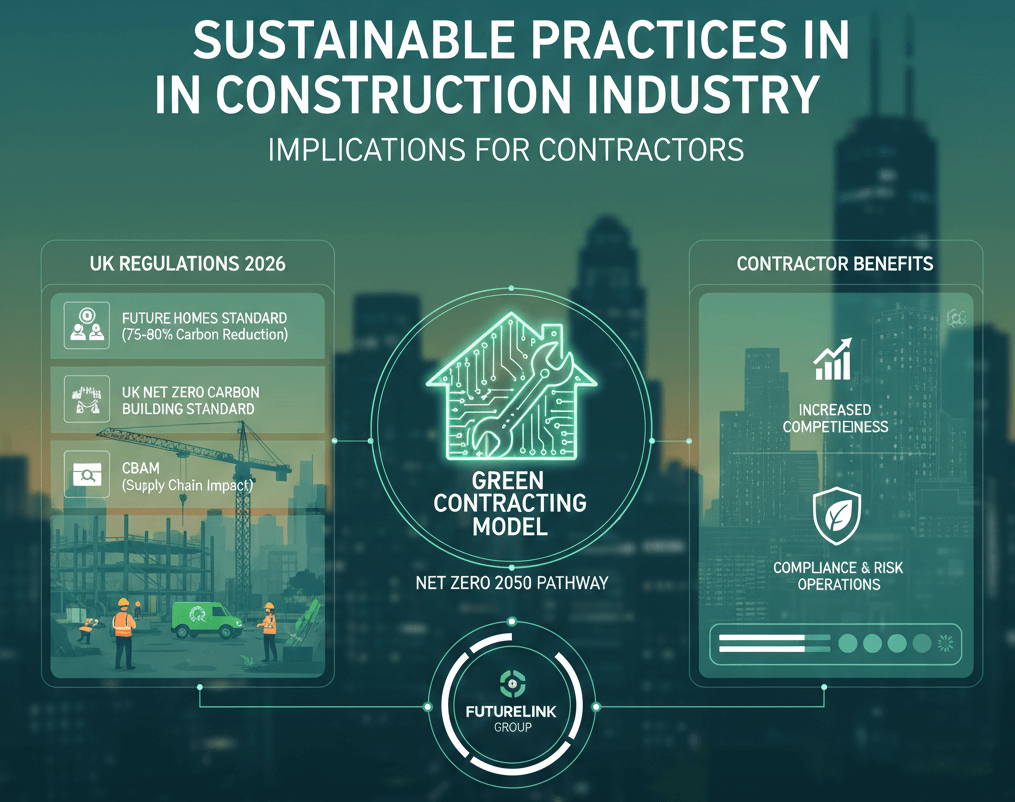
- Future Homes Standard: Effective from 2025 and fully influencing 2026 projects, this mandates significant carbon cuts in new residential builds through energy-efficient designs and low-carbon materials.
- UK Net Zero Carbon Building Standard (UKNZCBS): Launched in early 2026, it provides a verified framework for whole-life carbon performance, covering embodied and operational emissions, increasingly sought by developers and investors.
- Environmental Improvement Plan and ESG Focus: Updated in late 2025, this drives biodiversity net gain, circular economy principles, and reporting on sustainability metrics.
- Carbon Border Adjustment Mechanism (CBAM): Set for 2027 but influencing supply chains in 2026, it impacts imported materials like cement and steel, pushing contractors towards low-carbon alternatives.
Non-compliance risks fines, project delays, and lost tenders, making adherence critical for ongoing work.
Core Sustainable Practices for Contractors
Contractors can implement actionable steps to reduce environmental impact while maintaining efficiency.
- Low-Carbon Materials: Prioritise recycled aggregates, engineered timber, low-embodied-carbon concrete, and alternatives like cross-laminated timber to lower upfront emissions.
- Waste Reduction and Recycling: Adopt circular economy approaches, such as on-site sorting and high recycling rates, to minimise landfill contributions and meet targets.
- Energy-Efficient Methods: Use modular construction, prefabrication, and energy-efficient tools to cut waste and operational energy use.
- Whole-Life Carbon Assessments: Incorporate tools for measuring embodied and operational carbon, aligning with emerging standards like UKNZCBS.
- Biodiversity and Site Management: Implement measures for net gain, water conservation, and pollution prevention on sites.
These practices not only meet regulations but also improve project outcomes through better resource use.
Benefits for Self-Employed Contractors
Self-employed workers in construction gain tangible advantages from sustainable approaches.
- Competitive Edge in Tendering: Clients and agencies increasingly favour contractors with green credentials, certifications like BREEAM or ISO 14001, and proven low-carbon track records, leading to more opportunities.
- Cost Savings Over Time: Efficient materials and methods reduce waste, lower energy bills on sites, and decrease long-term maintenance liabilities, boosting net income.
- Access to Incentives: Tax reliefs, grants, and rebates for sustainable projects, plus potential for higher contract values in green-focused sectors.
- Enhanced Reputation and Retention: Demonstrating eco-responsibility attracts repeat business and partnerships, while aligning with personal values in a sector under scrutiny.
- Future-Proofing Career: As regulations tighten, sustainable expertise positions contractors for growth in retrofitting, renewables integration, and net-zero projects.
These benefits support financial stability and professional growth for independent operators.
How Futurelink Group Supports Eco-Compliant Payroll
Sustainable operations extend to back-office efficiency, where compliant payroll plays a key role in supporting green practices.
Futurelink Group’s solutions, including CIS payroll, umbrella PAYE, and PEO arrangements, ensure full HMRC alignment while enabling contractors to focus on sustainable delivery.
- Streamlined Compliance: Automatic handling of deductions, RTI submissions, and IR35 status supports focus on low-carbon work without administrative distractions.
- Access to Benefits: Statutory entitlements like SSP, SMP, and pension enrolment promote worker wellbeing, aligning with broader ESG goals.
- Financial Efficiency: Fast, same-day payments and transparent fees help maintain cash flow for investing in eco-materials or certifications.
- Insurances and Support: Included coverages (public liability, personal accident) provide security for sustainable site practices.
By outsourcing payroll complexities, contractors dedicate more time to adopting green methods that drive project success.
Conclusion
Sustainable practices in the construction industry in 2026 represent a fundamental shift driven by regulations like the Future Homes Standard and UKNZCBS, offering contractors compliance security, cost efficiencies, and competitive advantages. Self-employed professionals benefit through enhanced opportunities, financial gains, and career resilience in a net-zero-focused market. Partnering with reliable support systems streamlines operations, allowing focus on delivering eco-friendly projects that contribute to the UK’s environmental goals.
Get Started Today
Ready to embrace sustainable practices with compliant, efficient payroll support? Contact Futurelink Group for a free consultation on solutions tailored for construction contractors. Call us on +44 (0) 1923 277900 or email sales@futurelinkgroup.co.uk.
Frequently Asked Questions About Sustainable Practices in Construction
Contractors often seek clarity on sustainability requirements and benefits. Below, we address common questions based on current UK regulations and industry trends.
Key drivers include the Future Homes Standard for new builds, the UK Net Zero Carbon Building Standard, and updates to the Environmental Improvement Plan emphasising low-carbon materials and circular economy principles.
Benefits include cost savings on waste and energy, access to incentives or rebates, higher tender success rates, and potential for premium contracts in green projects.
Initial costs may be higher for some low-carbon options, but long-term savings through efficiency, reduced maintenance, and compliance advantages often outweigh this.
Efficient payroll frees administrative time, ensures financial stability for investing in green tools or certifications, and aligns with ESG reporting through structured, compliant operations.
Consider BREEAM, ISO 14001, or demonstrating carbon reduction strategies to meet client and regulatory expectations.
We provide compliant CIS, umbrella, and PEO payroll with fast payments, insurances, and support, enabling contractors to prioritise eco-friendly practices without back-office burdens.

Craig Moss
Craig Moss is a seasoned professional in the employment and recruitment industries, based in Kings Langley, UK. With over 30 years of experience, including a successful tenure as a central London realtor handling properties up to £3 million, he now leads an exciting management role at Futurelink Group. Specialising in compliant payroll solutions for contract recruitment, Craig helps clients increase margins by up to 30% while navigating complex legislation. His people-focused approach, honed through decades in sales and people management, ensures both recruiters and workers benefit from tax-efficient, compliant solutions. Passionate about building strong relationships, Craig thrives on delivering results that drive business success.